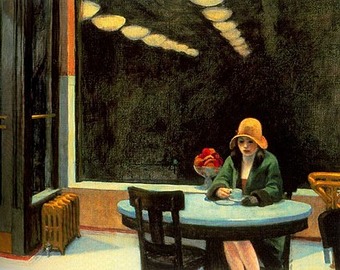
Edward Hopper, Automat (1927; Des Moines Art Center)
From ages back, across times and cultures, people found a place of solace, of refuge, of peace in a cafe, pub, bistro, brasserie...call it what you will. I imagine every civilization had such -- from the Roman taberna to Hemingway's "Clean, Well Lighted Place." I'm not talking about a raucus bar, a dripping bawdy house, or gambling hole. Rather, you want an island of peace and civilization, whether you're sitting alone or with friends; there you find a haven of reflection, talk, reading, writing -- and all with excellent fare.
Solace in a Haven?
No, I don't mean a place of morbid self-submersion or narcissism either individual or collective, but a place where your thoughts have room to breathe and talk between friends lends light and sharpens ideas. That is just why the Inklings (J. R. R. Tolkien, C. S. Lewis, Charles Williams, Hugo Dyson, and others) met in a favorite pub in Oxford Tuesday and Thursday mornings about 10:00 for a pint and a stream of sparks and wit.
Another example: during World War I, many soldiers found their refuge from the metal storm in an estaminet. William Orpen, Irish painter and one of the official war painters of WWI, did a self portrait in just such a place in France.

William Orpen, Ready to Start (1917; self portrait
in an estaminet; Imperial War Museum)
The self portrait is titled, Ready to Start -- and self reflection (here literal and metaphorical) makes a good start to any significant event -- as well as restful pause in the middle of that event. As in Orpen's painting, the actual estaminet is vital aspect of the experience -- almost another "character" in such a story, really.
Like many such places, they are often found slightly out-of-the-way, though that aspect is relative to any town. In the 1980s I found an escape just off London's Trafalgar Square -- in the little end nook upstairs at the Chandos. While the Chandos can get very busy during football matches (huge camaraderie and fun if also deafening) and on a theatre night (some venues are just up Charing Cross), earlier in the day you can find it a place not only to sip coffee, a pint, or eat your fish and chips while hiding away, but also read, write, think, talk with a friend -- even while taking a peek out a little window opening on an unsuspecting crowds by the National Portrait Gallery.
What's the Big Deal?
Why are these little islands of peace important? Well... During a conference in Salzburg, Austria -- a conference on suffering and trauma in 2012 -- someone who worked daily with the dying in hospice remarked the absolute necessity for retreat. He mentioned that when he needed a vacation, what was most important was to find his "palm tree." His "palm tree" happened to be a literal feature of his usual island escape, but he said it was, of course, metaphorical also: it means a place to reflect, rebuild oneself, to come to terms, iterate things that needed to be understood, and all within a place of no pressure. He said, "you have to find your palm tree and sit your ass under it" and renew yourself -- and if you do not, you will only continue to deplete yourself; if you do not, you will have nothing to offer others.
Just such a place in Salzburg, Austria, is the unassuming Das Kaffeehaus. Like many havens it is a bright and tranquil spot in the midst of chaos. Associated with the 4-star Hotel Melanie, it has a platform deck outside just off one of Salzburg's stone, arched entryways. Inside, it opens into what I call "thoughtful spaces"; their philosophy?
"For us, giving yourself breaks is a kind of insider tip for happiness in everyday life. When the soul laughs, every day finds a happy ending!"
Oh! That's precisely a "palm tree!" After finding this place, we visited daily -- sometimes twice, morning and late afternoon. It is, literally, a great escape from the churning crowds at the Dome, the various Platzes, the day-trips out. Sit, eat, think, talk, draw, read, and watch people (and occasionally horses). As the case in most of Europe, but especially here, such a haven is made for the human being in totality.

Choose a Common Room -- or a Cozy Nook (British "Snug")
And their fare? They say they "spoil" their customers. True! They make their own pastries, tarts, cakes, swirls...from old family recipes. Meats, cheeses, yogurts. Emphasis on healthy. Coffee: seriously good in whatever form your caffeine takes. And cocoa! Drinks: it's like the best of the estaminets -- from simple, sparkling mineral water and orange juice, Campari with orange juice or soda, to wines, or prosecco to celebrate with. They have it.

Kaffeehaus Fare -- Beyond Home Made (a hat on the egg;
hand-tied napkins). What's not to Love?
In the very best sense, it's a clean (!), beautiful, well lighted place with amiable and accommodating staff: real smiles and good humor from Sabrina and Birgit -- from everyone. And...they happily adjusted for food allergies.
We did not stay in the hotel, but certainly the great attention paid to the Kaffeehaus is an indication of the fine quality of the hotel. Next time in Salzburg.... But such places are important -- vital, and nurturing to the soul.


No comments:
Post a Comment