Friday, October 16, 2026

MOO (in Chamonix): Real Food in a Humane Haven

 
 MOO, Chamonix

So.  Here's how it goes.  You're in Grindelwald, Switzerland.  Early morning.  Leaving for Chamonix, France.  But there is no direct route by train to Chamonix.  So you ride a number of trains back the way you came in order to get to larger stations, catching more popular lines before heading west toward Chamonix, changing trains no fewer than 5 times, each train getting smaller, less populated, until you're on the narrow-gauge number from Martigny, clinging to a steep path, climbing up along cliffs, looking down into the valley's abyss just beside you, emerging from tunnels to even higher climes, to find...Chamonix.

It's how you get there.

And when you emerge from the Chamonix-Mont Blanc train station, you move away from the loud American voices clanging with the flat accents that have made you cringe for some hours.  You can be excused if you give in -- even when asked directions: "Oh!  Je suis desole.  Je ne parle pas anglais."  To you anyway....  You shrug, aching for a quiet lunch, and....

Head down the street from the station.  There are the usual tourist restaurants just here, there.  You can see the crowds of tourists clamoring.  But further on -- there.  Yes.  Those are locals. 

I don't usually discuss food in any detail in this blog, but in Chamonix, there's this: MOO.  If the huts high in Switzerland offer some unexpectedly solid country fare to hikers, MOO departs from what any ski-town pub offers and delivers real cuisine.

What drew us to MOO?  Those locals.  Sure -- a few tourists are at lunch, but mostly locals who dine there daily.  What's special about it?  The cuisine (and I don't mean "food").  They have three or so real chefs whose imaginative plates and refined skills you would never expect in a ski-town pub but also in a place just down the street from the train station.

Don't ask for a burger for lunch; sensibly, they won't do it and you will learn something.  The lunch menus, plats du jour, are different each day.  This is not pre-packaged, re-heated pub-grub.  Their plates are all created from local sources.

So.  Lunch: you have three options which are each unique -- say, a meat plate (that may be a curry, an Asian twist, or a French original), a fish dish (supreme, gentle), and a vegetarian dish (which even a meat lover would relish).  As we ate lunch there daily, we tried over a week of innovative dishes that one might expect to find in good restaurants in Paris or Reims.  There is brilliant consistency in the quality even with the daily variety.  And...if you need, they are quite conscious of dietary allergies.

But even before you begin the main, there are likewise innovative salads laid out: you serve ourself from the thoughtful options that are also made in-house, but include a generous and -- did I say "innovative"? -- world: potato salads (including one surprising sweet-potato salad hinting of ginger), pasta salads, carrot salads, beet salads, lentil salads, and, of course, various fresh greens and crisply blanched and dressed vegetables, as well as sliced brie and other cheeses, bread, and nuts.  Not only may you try them all, but you may return for more!  Amazing.  The offerings here change daily, as do the mains, but as with everything they serve, it is REAL food, not processed, packaged, or dare I say, "American."

Yes, and after lunch, desserts.  Real, created, traditional as well as innovative offerings -- even if it may be an after-lunch moment of imbibing (the espresso martini is balanced, not the over-sweet, foo-foo thing they tend to be in America). 


Hot and Cold: Chocolat Chaud et Espresso Tini.  C'est Magnifique.

As for their burgers (again...not to be ordered at lunch), I don't know -- we unfortunately never went there in the evening to eat.  They can only be as fine as the menu hints (real variety) as with their lunches. But look at the offerings: MOO Burgers/Evening.

Et combien?  And how much?  All this is astoundingly reasonable -- even economical.  How do they do it?! 

The staff: of course, they are locals, and are invested in MOO.  They care and you can see it.  MOO's motto is Walk in, Dance out."  You do!  The staff are central to that: they are delightful and will take time to talk a moment.  In less-busy moments, you get to know something of these people's lives.  Some are from the area (Seline, who has climbed one of the needles above Chamonix, and has a very bright, artistic son who, himself, is a rising climber), some from Sweden (from whence the owners hail -- ), and from England, like Ellie (who is also a professional in kinesiology).  They are talented, professional, and solidly genuine people with great senses of humor.

Moo is simply a marvelously humane haven.  I'm going to have to go back for an evening burger. 

MOO?  The name is from the first initials of the owners.  And Susuanna:

 
Susanna

Well, an owner will have to tell you that story and why her head is on the wall.

 Hej så länge, kompis....


Thursday, October 15, 2026

Into Thin Air (3): The Alps


The Chalet in Grindelwald, at Alpiglen, Looking 
Toward the Left Side of the Eiger. (Source: author)

It's true what was said in another "thin air" post: you have to escape sideways land and go to up-and-down land.  And the Alps are a remedy supreme.

Yes, the Alps are a "squeezed" version of the mountains you find in Colorado, with both mountains and valleys between them pinched to extreme narrowness.

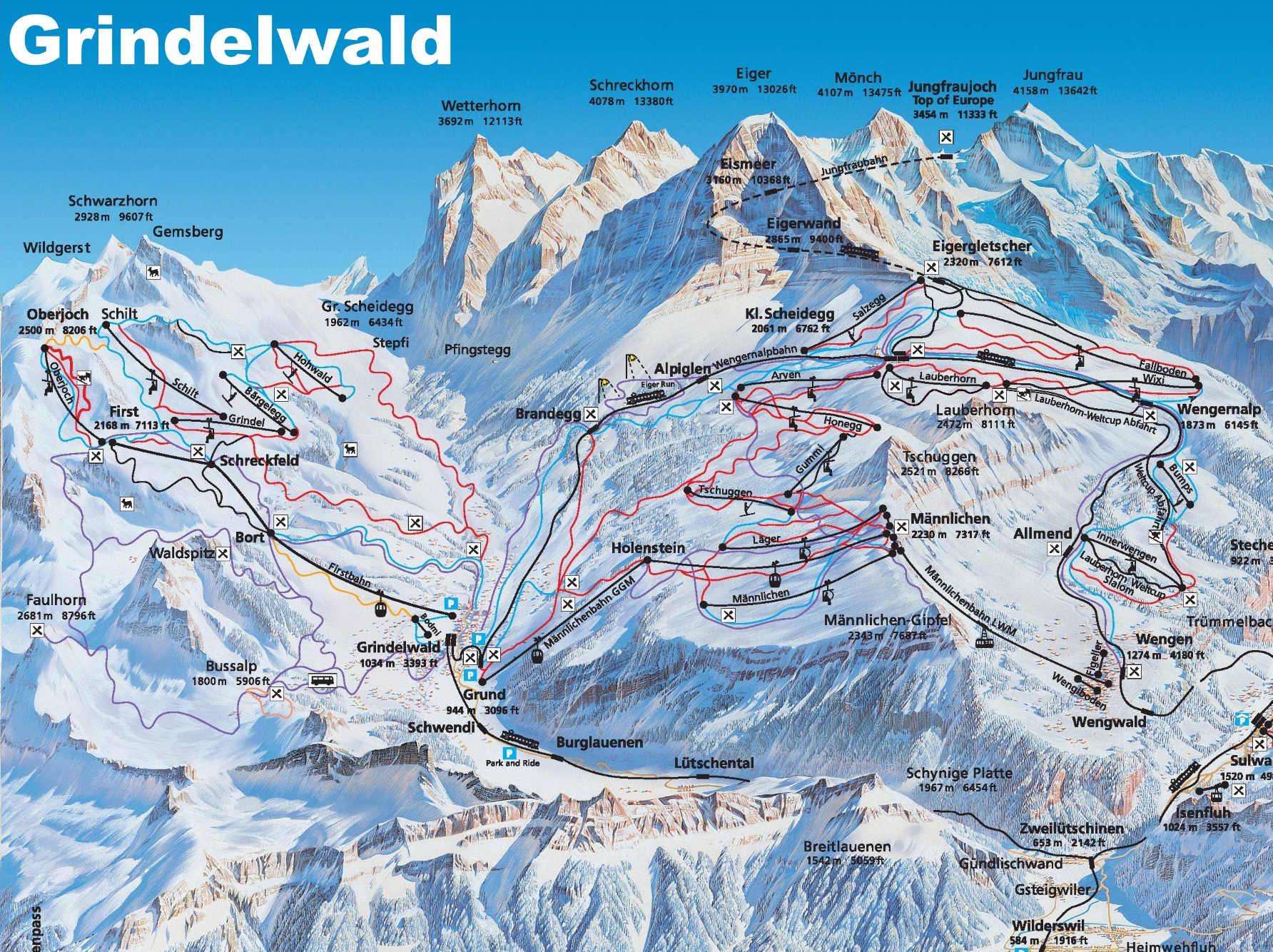
While dozens of miles lie between the bases of mountains in Colorado, Grindelwald, Switzerland, on the other hand, presents a panorama of very famous mountains very close at hand.  Springing up from the land just across the road from your chalet are the Wetterhorn, the Mattenberg (itself the step up to the Kleine Schreckhorn and Schreckhorn), and the jagged peaks of the Finstraahorn and Flescherhorn just beside -- themselves just left of the Eiger.  All of these rise up along the roadways round the village of Grindelwald.

https://ontheworldmap.com/switzerland/ski/grindelwald/grindelwald-piste-map.jpg 
 Grindelwald and Environs (click for larger map) 

Nearness is what you notice.  But more: the astounding angles they pose, rising steeply and unrelentingly from their bases.  And that is true for all the Alps: French, Italian, and Austrian.

Yet it just may be that the sharp, rising angles seen from valley to peak are even more extreme in Chamonix, France.  There sits the ponderous and frosted Mont Blanc, of course, rising 15,700+ feet above the village and valley, looking so close from the balcony you might touch it (a deception, of course, yet so it looks).  But along the ridges surrounding Chamonix are those needles of rock pricking the very sky as paragliders thermal like butterflies above and around them.

Indeed, even the narrow-gauge train from Martigny to Chamonix -- it's how you get there -- clings to a path just wide enough for it to creep along the edge.  Along the climb up, you find points of solid rock on one side and a thousand feet of thin air on the other.  Going around the outside turn gives you real pause -- is the train tipping off into the air?  A little.  But it clings to the track.

https://images.ctfassets.net/ukaa6ik2569a/5SmAv058HVWvNK87C2cTd0/aa0925064eb8ffa73df09f2ef4961f5b/ST_3x2_Finnhaut-Mont-Blanc-Express_109404.jpg?f=center&w=2560&h=1706&fm=jpg&q=80&fit=fill 
Train from Matigny to Chamonix (Source: ctfassets) 

And as the train climbs, villages slide into view, perched upon the cliffs, houses stacked nearly atop one another on some narrow ledges, surrounded by more cliffs straight up and steep drops down.  Little train platforms appear and, passing these, you note not 500 feet beyond that you can only see the tops of the buildings.  Most village folk would be unable to look across to their neighbor's house and nod a "hello"; they can only see the rooftop immediately below their own house -- or the granite foundation of the house above.

What a village to live in!  The quick jaunt to the store for bread would be a sweaty affair, climbing and descending those streets.  How cars navigate them in winter...anyone's guess.  Then you realize that the ride back down on the train requires very good brakes and find yourself asking hopefully, "Hmm.  Do the French use the Swiss cog-train system?" (protecting the train from one very short and speedy careen to the first curve, tossing all the cars straight off the mountain).

But to wander (German word) -- to hike.  Even a moderate climb on the trails in Switzerland to the many  huts in these mountains brings you to some real, unguarded exposure, but also to what you're there for: the beauty and the sense of "Wow!  How did I get up here?!" as you take in the massive peaks and views that literally make you gape while you balance on rubbery legs.  I'm too old now to use a rope and attempt vertical walls, but there were moments on this month-long trip -- moments where I considered, "Hmm.  My rope wouldn't be amiss just here...."  Photography in such moments fall in priority to footing. 

https://switzerlanding.com/wp-content/uploads/2023/06/Pfingstegg-to-Baregg-Hut-768x548.png
On the Way to the Baregg Hut (Source: Switzerlandlanding) 

These huts, perched high on small outcroppings in the mountains of Switzerland are great delights in themselves.  Hot chocolate (um...Swiss chocolate), sausages (wurst), kartofelsalat, sauerkraut, rostis, and...friendly staff if you, at least, greet them with a smiled "hallo," using even a little German or French.  Some of the huts are not only exposed but are set high up on the most precarious spots along a trail -- like the Glecksteinhütte above Grindelwald, at least a four-hour one-way event with some dicey points.  A jaunt to the Bäregg Hütte (Live Cam) is much shorter, albeit not without some exposure.  Just so: one family on their way down with a young girl improvised a harness onto her with leash -- in case.  


Heading to the Baregg for the View across to the Glacier (Source: author)

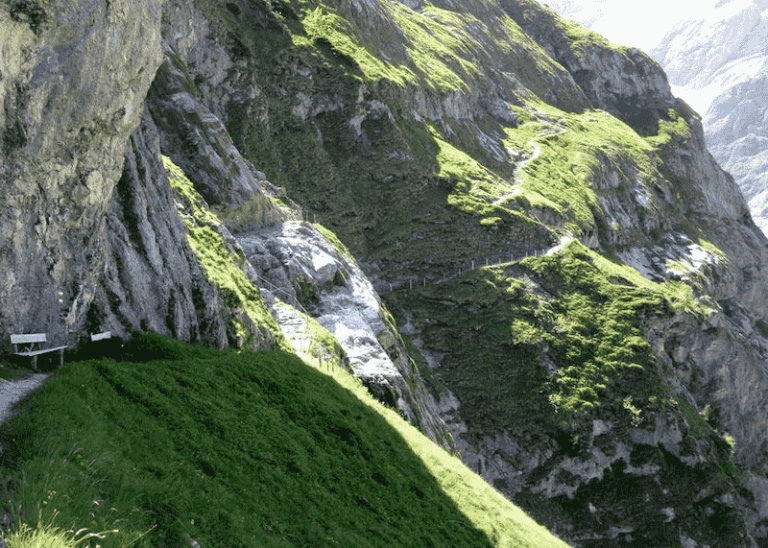
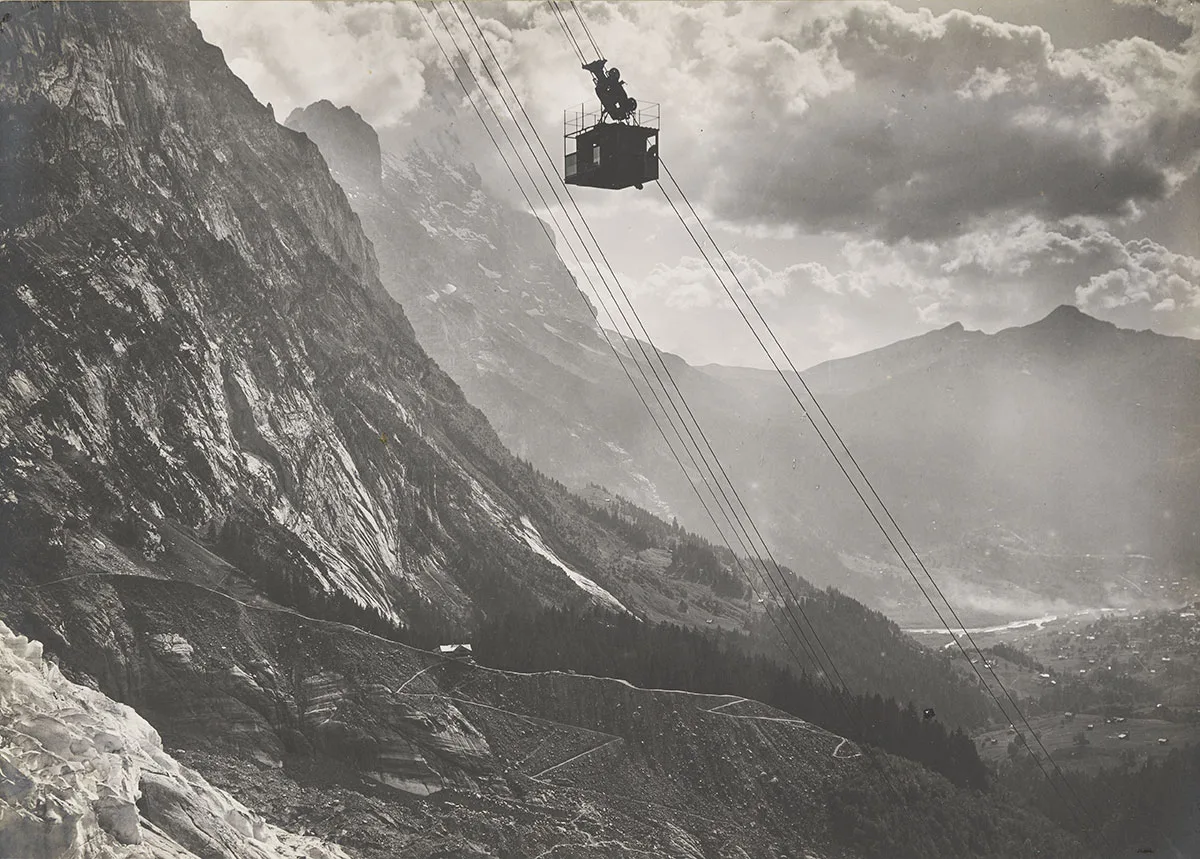
If you go up past the Hotel Wetterhorn, east of Grindelwald, you find not only a wonderful world of steep and lush woods (just where the first modern gondola on a cable system was built), but also trails at the base of granite walls towering so closely above that you have to lean back to look at them.  At one point a sign indicates, "Frequent Rockfalls.  Don't Loiter Here."  The Upper Grindelwald Glacier (Oberer Grindelwaldgletcher) still exists, but only way up the mountain today.  It can hardly be seen from the entrance to the glacier gorge, while in 1973 it was 4.1 miles long, and "only 20 years ago the glacier tongue reached the entrance of the gorge" (Our Heritage).

Switzerland’s first aerial cableway for public transport on the Wetterhorn, 1909.
The First Gondola, Wetterhorn, 1908. (The Glacier 
lower-left, the Oberer Grindelwaldgletcher, 
has long since receded up the mountain today.)

And there's Chamonix, with, is it possible?, hikes even steeper in points.  Not so steep is the Grand Balcon hike (mostly downhill in this direction): from the gondola station at Plan de l'Auguille to Montenvers and...well...what's left of the Mer de Glace glacier.  This direction means going from high Alpine tundra down into deep steep woods.

https://tourdumontblanchike.com/wp-content/uploads/2026/03/path-mont-blanc-2-768x575.jpg 
 Grand Balcon Hike, above Chamonix (Source: dumontbanc)

Along the way, huge masses of granite, fallen from the stone needles towering above, are covered with the same, bright green lichens you find in Colorado's mountains, but here -- way above the tiny, softly humming helicopters busy as bees in the valley below -- you meet the Chamoix (say "sham-wah"): cute, short-horned and somewhat shy mountain goats.

 
A Chamoix Peeps above Chamonix (Source: author)

At the end of this hike, you come out of the trees to find, set on the rock above the scoured gorge where the thick glacier once crept along its icy way, the elegant stone Hotel du Montenverse with its restaurant and patio allowing a look across and down into the valley.  Here's a very nice, cool drink among the peaks and talk with visitors -- in this case from England.

But how to get down?  The bright red, old-timey train, nearby -- another narrow gauge affair: in areas, the steepness most definitely requires a cog-wheel system. But even then, the cars, with their polished, wooden-slat seats straight out of the 1920s, hardly keep you from sliding off them and across the floor as the train angles down the mountain track.

https://img.20mn.fr/-fC0V-TsRlWZ2lEpBTBiIw/1200x768_petit-train-cremaillere-montenvers-restera-ferme-mercredi 
Weedling its Way Down (Source: cremailler)

 There's nothing like up and down land.  Nothing.  As I've said before, it's no good reading about it.  You have to go there....


Thursday, June 25, 2026

Fourth of July 250: A Pledge of Compatriots


The writers of the Declaration of Independence closed their document with a pledge:

And for the support of this declaration, with a firm reliance on the protection of Divine Providence, we mutually pledge to each other our lives, our fortunes and our sacred honor. 

Nice.  It seems comfortably fluffy because of our familiarity with it.  In reality, it carries an extreme weight.  To decide to oppose your king by force, to declare that he has no authority over you or your land -- that's treason (in a royalist's perspective). 

So when they say, "pledge to each other our lives, our fortunes and our sacred honor," they mean it literally: if they had failed to secure liberty from the king, they would literally have forfeited every last thing they possessed and, of course, their lives; their families likewise would have suffered destitute circumstances as well as, very possibly, death.  Yes, the consequences would have stood equally for each of those who signed the document (with John Hancock placing his signature in very large script to be prominent -- a message to the King).

An honorable endeavor?  Well, if they had failed, the king would have cast their cause linguistically as being ignoble, treasonable, and their ideals and deeds as opportunistically criminal.  Yes, in the case of failure (as as is the case under any despot), citizens wanting to protect themselves would never have openly stated that the patriots' cause had been honorable: the signatories would all have been made examples of -- at the very least being publicly (and probably slowly) killed.  (And just why is it that the concept of "honor" doesn't seem to weigh very much in the collective American mind these days?)

But they both endeavored and succeeded despite these risks. 

Close-up of a document with handwriting

Description automatically generated

John Hancock's Huge Signature: "In Your Face, Georgie Boy!"


During the American Revolution, one of my ancestors, Capt. Fredrick Cramer, from New Jersey, fought along side George Washington.  An account has it that during one of the various battles during which Washington was nearly killed, his horse was shot from under him.  As officers typically rode white horses (well...George had at least one brown one), a white horse was an honor and a duty since your men could see you clearly as you led them in battle (and a white horse also made you an easy target) -- Cramer handed his white horse to Washington.  A noble act?  Maybe....

Another of my ancestors, a Richards from North Carolina, ran into the woods with his son as the British invaded his village and tried to rid the place of patriots.  The document indicates Richards "was murdered and his wife killed" for their support of independence: they had been hiding patriots in their house.  I'm not sure there's a great difference between "murdered" and "killed," dead seeming pretty much the same for one as for the other.  But linguistics: the king had defined them as "rebels" and supporters of "treason," even as Thomas Paine and others were defining the king's actions as tyranny against inalienable human rights.  He who controls the definitions....  How did the king label those who participated in the Boston Tea Party?  We call them Patriots today.  But back then?  See the ironies in the use of definitions and labels employed by those of the dominant ideology.

It's a serious undertaking to oppose a king.  That is just what "protesters" and "rebels" for true liberty in any country have gambled: their actual lives and fortunes and honors in order to be free of despots and dictators, manipulators of the laws and industrial-political connivers, equivocators, and their linguistic-legal machinations.  They, too, risk literally everything, and many, like my ancestors, have paid with their lives for freedom.

There are other ironies inherent in this independence we have: we still pay taxes on tea and windows.  Imagine that.  Legitimate (disinterested) taxation by representation of the people?  And so...who doesn't think that tax dollars (billions) are wasted every day in Washington?  Even given the inconsistencies and ironies, the freedoms to be had in the US stand apart from those in other places throughout the rest of the world.  Simply put, freedoms are immense in the U.S. -- absolutely immense when we think about the histories of many other countries.

Yet...I've come to think that Americans' right to pursue happiness is often taken well beyond reasonable, equitable, or mutually beneficial.  Does that "right" seem today to mean solely, "I can do whatever I damned well please," but fails to include my responsibility for how my actions impact the welfare of others?  So it seems to many Americans I meet here and abroad.  It violates the social contract that the Constitution and other founding documents lay out as Jefferson & Co. saw them (and wrote them).

For instance, the Greeks (whose ideas of democracy largely became our own) saw a person who pursues solely his own interests at the expense of others as an idiot.  Idiot is a word we get from the Greek, ἴδιος -- someone who is a private person, concerned only with their own affairs and pursuits without consideration for how their deeds affect the good of the city-state, they do not care about the good of all the people, the πολλοὶ -- the very people around them who share the same community with its rights and responsibilities.  Yet these are people with whom you have a social contract: you agree to abide by the shared laws for the good of all, even at the expense of limiting some of your individual, private freedoms. Since an "idiot" acts solely for themselves instead for the social contract and the good of all, an "idiot" is the least desirable person to be a politician -- and the most unfit.  These are the principles the country was founded upon.  Principles are the guide, not "convenience" to an interested party.  Again, read your Hume and Locke, if not also your Plato.

In this context, idiocy means, say (on a large scale), collusion between crooked politicians, big-business magnates, or a collection of Bernard Madoffs (am I being redundant here?) who ferret away their own special-interest packets while not working for the public's best interests -- who work against the rights of all within their society.  Lobby-ism.  "Corporations are people, too."  Not.  And when that idea undermines the Constitution, the people's rights, and the laws that were written for and protect the individual, not a corporation, then it all comes at the public's expense and the encroachment on and demise of their rights and freedoms.

On a smaller scale, idiocy means the self-serving individual who stands in the middle of the aisle at the grocery store, blocking the way, oblivious to others in the aisle, or the person who rides sloowwwly down the interstate in the passing (left) lane...blocking traffic.  Idiots.

Watch the police (from the Greek, polis, city) move one of these idiots over:


The writers of the Declaration knew this word, ἴδιος (Jefferson and others knew Greek and had read their Plato...as well as Locke and Hume).  We were never meant to be so free as to climb over others or impede others' freedoms while pursuing our own.  And Plato clearly saw a suitable politician as someone who is not intent on building their own fortunes.  Read Plato's work The Republic.  The writers saw it as Freedom with Responsibility for others.  (Is it just me, or is it contradictory to this sense of responsibility that "Capitalism" has come to mean getting ahead -- and doing so in predatory fashion -- at the expense of others?).  But responsibility: that's a large part of the Greek way -- um, the ancient Greek way.  I have no idea how this all applies to Greece's current financial situation.

You might also look into the Greek word  ἀμαθία (amathia), "willful ignorance," a refusal to learn the truth of a situation, really.  (An absolutely first-rate blog on this word is HERE.)

 
But the "pledge" in the Declaration, that is a pact made among friends, among compatriots -- I have friends of many years, friends I can lean on, who know my worst and best, and of whom I know the same, and we don't throw these important connections away.  I like to think that friendship is based on not only what the friends share in common, but on a sacrifice to support each other in both freedom from things we do not desire and freedom to pursue things we do desire.  Isn't that called "happiness"?  And it's mutual.  It involves respect for an individual's sovereign independence as well as respect for our mutual good.

Friendship is a democracy, then, enabling individuals to pursue their own and others' best interests. Friends "mutually pledge to each other our lives...," as the Declaration says.  If that breaks down, notice how friendship ends -- or should end, by common opinion.  So I see it.  And that's what happened in the 1700s between King Georgie's England and the colonies: an end of friendship, just as the Declaration states it.

This 4th of July, I celebrate the "friendship" of my ancestors and relatives who sacrificed much for what I now enjoy, including great-uncles Chris and Pierre who were in France in WWI, brothers Jimmy and Bill, both of whom were at D-Day in WWII.  And I celebrate not only these who have passed but also my current military friends like Corpsman Vinny C., "General" Ruxlow, Lt. Col. Hurt, and CW3 "Ron Mexi" Shawn, Major Nurse Jacki,  "Majormajor" Tom, Purple Heart "Owie" Brekke, and many others who have personally sacrificed to retain freedom for us, but I also celebrate well-loved friends who have shared freedom and mutual good with me over many decades.

What a very rich place this land is -- rich no less in friendship.  It was personally costly to create, is personally costly to retain, and well worth sacrificing for, I think.  And it's always a sight nicer without idiocy.